Sunday, April 17, 2011

4/15 - Going home the long way. Kittitas and Yakima Counties.

Snow on Snoqualmie
I included this picture just because I had announced the beginning of spring in the last post.  Seems I'm eating crow... so to speak. 

Bluebird box in snow - Umptanum Road
This was the first year that our track team had an athlete competing at the Pasco Invitational.  Our distance coach went over as the 'official' coach for the trip, and I decided to make it a birding-visiting with family-see some awesome running weekend.  Growing up in Yakima, I had made the trip from Ellensburg to Yakima so many times on Highway 82, and a handful of times on the Canyon Road (Highway 821), but I'd never gone all the way over Ellensburg Pass (heading up Umptanum Road from Ellensburg, then descending on Wenas Road to Yakima).  I made a late morning start to make sure that I beat whatever weather might come, and got to Umptanum Road by 1:00.

I made it to this road for the first time last May on an awesome trip through Kittitas county.  I may have had a full dozen lifers on that trip - I'd just never reallly birded the East side in the summer!  Sage Thrashers, Vesper Sparrows, and Western Bluebirds were new for me last year here.  I knew it might be early for them, but by heading over the top of Manastash Ridge, I was hoping for some other birds I'd never seen before.  The first real stop for me was to see if the Red-tailed Hawk nest was still there in the same tree as last May - yes indeed!  Last year, I only caught this because of a hawk flying into the tree, but it's nice to be able to find it again, and to see the nest in use.


Spring colors on Umptanum Road
 Even with Kittitas County being a just-passing-through county, I've been able to add to the county list along the way, and the trip up Umptanum Road actually got me into the 30's for the county.  A few Western Bluebirds scattered as I drove the road, and little bunches of trees like the ones above had Ruby-crowned Kinglets and White-crowned Sparrows.  After passing into Yakima County briefly, I pulled off into the parking lot for the hike to Umptanum Falls, taking me back into Kittitas.
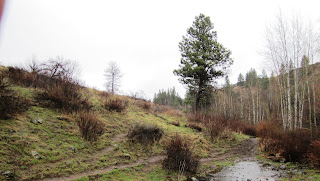

This is the first place I ever backpacked - with Boy Scouts years and years ago.  It was a fun trip (and we did take Wenas Road - with our troop leaders pointing out the bluebird boxes as we went), and doing this hike again last year.  I hadn't planned on doing this hike today, but couldn't pass it up!  In a month, this will have flycatchers and warblers and Red-naped Sapsuckers.  It was a quiet walk today for both birds and people.  Three thrushes (American Robin, Townsend's Solitaire and Varied Thrush) joined the Western Bluebirds I'd seen
part of the 'trail'
 earlier for a four thrush day.

I had kind of wished that I had brought the old mudders on the walk - would have made parts of it much easier - but I was happy to find that, even when it was muddiest, there was a way across.  Sometimes there was a short way or a long way through the mud, but it always seemed like if I looked around a little, someone had been there before and left good places to walk - a few thick branches, or maybe rocks.  Made a mental note of that and kept moving.

Getting to the "bridge" at left had me using colorful language for a moment.  I don't think cameras respond well to going into rivers.  It was passable, though.  The end of the my walk was at the falls.  Waterfalls, like lighthouses, are one of those things that Bre and I both really enjoy (she never gets tired of Snoqualmie Falls), but we haven't been to this one together yet.  We'll have to remedy this soon!  I traipsed back to the car, and hopped back into Yakima County.


Umptanum Falls

On most of these trips, I 've been sending out queries for ideas and help.  This time around, I ended up getting a hold of Jeff Kozma, a wildlife biologist who has been studying White-headed Woodpeckers nesting in managed stands of Ponderosa Pine.  This stretch of road is in some ways 'the office' for Jeff on a fair number of days!  He let me know about some of the species I was looking for, and was especially helpful with information on the woodpeckers, as well as White-breasted Nuthatches, which often share the same kinds of habitiat on the east side.    Driving over Ellensburg Pass looking for one of the first stands of pines that Jeff suggested, I had to stop the car at Observatory Road!  As an astronomy major a the University of Washington I had been able to use (and nearly fatally wounded) the telescope at the Manastash Ridge Observatory.  This was one of the most amazing remote places I'd been to, and being able to stay up all night looking at the stars was a dream.  We used to take the shortcut back then, coming directly from the north, but that road is no longer passable, so this southern entrance (gated) is the way in now.  Walking the parking lot, I was treated to booming from a Sooty Grouse!  This was a sound I had never heard before - I've only seen these grouse flushed (Naches Pass area) or scattering off of the side of the road (Hurricane Ridge).  No visual today, but the booming was quite a treat.


 I kind of struck out on woodpeckers and nuthatches in this area (although the meadowlarks were singing, and I did find a  Vesper Sparrow), so I continued on to Maloy Road.  This road took me to some dense Ponderosa Pine stands where I did find the WB Nuthatches I was hoping to find - my first life bird of the trip!  Red-breasted Nuthatches were also there, making their more familiar tin horn calls, and Steller's Jays and Ravens were also making noise in the canopy.  Two interesting things on the ground:  first were what I thought were golden-mantled ground squirrels (but the google shows something different for them), and second was a pair of Vesper Sparrows.  Two birds were foraging in the open -  if you look at the picture below, you can see why I almost stepped on them more than once!  They blended in so well, that I sometimes could only find them if they moved!  Camera batteries conked out, I went back in the car to change them, came back out, and couldn't find them.  I looked around, and started slowly walking to where I'd seen them last - and they scattered from my feet! Best pic below.
Townsend's Chipmunk

Vesper Sparrow in stealth mode

Swainson's Hawk - Wenas Road
From here, I made my way down Wenas Road.  I was hoping to head down Hardy Canyon, or any of the other little canyons to look for Ruffed Grouse.  Whoops!  Completely missed all of these roads!  I would love to go back and see just how primitive they looked.  Anyway, I came across two life birds on this little stretch that I was not convinced of or aware of until after I got back home.  First, I stopped to take a picture of what seemed like a very cooperative Red-Tailed Hawk.  I will tell you that I really don't enjoy trying to identify buteos (the hawk family that Red-tails belong to).  The thing is, it seems like Red-tailed Hawks are so variable, I just figure (as I did here) that every big hawk I see is some juvenile or morph that I just don't recognize.  When I got home I saw a Tweeters post from Randy Bjorklund that included a link to a picture of a Swainson's Hawk - and it seemed verrrryyyy familiar!  Going back, I realized that this is not a Red-tail, but a bird I hadn't seen before.  You get so used to seeing a lot of the same birds, the new ones get missed sometimes!

Wenas Valley (ween ASS  for those wondering.... there's no good way to say it)
Yakima Canyon

The next lifer went sprinting across the road shortly thereafter - a Chukar!  No picture - they hide pretty well - but I was not convinced at first that it was a Chukar, thinking that the little ridges around us were not Chukar habitat, but it seems that they are seen in this area.  California Quail skittered around on the hillside where I saw it run, so I thought maybe it was just a quail... that looked exactly like a Chukar.  The chickens at the farm nearby also confused any calls they might have been making!  Wenas Lake had a few ducks, and a Common Loon calling - something I'd never heard before!

I made it down to Selah fairly early - my brother was going to be getting back home at 7:30 - so I poked around on the south end of the canyon road (821) and I-82 before heading into Yakima.  The canyon road didn't produce anything extraordinary, but was beautiful.  Farther up the road at Roza Dam was the little area where we spent so much time waterskiing in the summer.

Highway 82 itself was not so productive, so I pulled over at the Selah rest stop.  House Finch, House Sparrow, Killdeer, and at the little ponds behind the rest stop - a Say's Phoebe!  I had only one brief encounter with this species before, so it was nice to sit and watch it flycatch.

Say's Phoebe flycatching

I made it back onto I-82 southbound (please don't ask how) and ended the day of birding.  I stopped at an important park in my hometown of Yakima - Randall Park.  Here's a few pics which are important to me, and maybe a handful of others who might read this. 
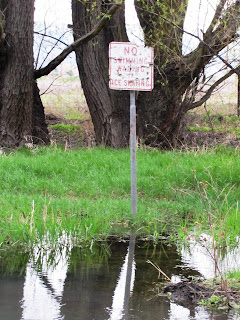
Them's the rules - we may not have followed all of them. 
I have been in this creek intentionally and unintentionally.

The smell here was beautiful.  30 years ago, and on this evening.

Friday, April 8, 2011

The Official Start of Spring - Ospreys, 3 month update, and county #10 done.

osprey = spring
There's a stretch of days in March (and this year into April) when I swing by this cell tower every day on the way to and from work, looking for the return of a pair of Ospreys (seahawks, as they used to be called).  It was a full week later than last year, but they did show up on the 2nd of April.  This is on the same pipeline trail where I started the year - maybe a half-mile up the trail.  In the three months prior, I had seen 150 different birds, set foot in 19 counties, and "finished" 9 of them (King(113), Whatcom(56), San Juan(56), Thurston(60), Wahkiakum(51), Chelan(41), Pierce(40), Skagit(39) and Mason(39). 

I was looking forward to finishing up teaching all the way to spring break, but following a track meet on the same day I saw the Osprey, my stomach started hurting...and a little more...and I finished out the day getting ready for an appendectomy!  My sister and folks took care of the kids while Bre took care of me at the hospital.  Another time this year when I've been so thankful for the family and friends around me.  Sunday came, and the appendix was out, it hurt to talk, and I wasn't allowed to pick things up!  I was grounded! 


Savannah Sparrow - Marymoor Park, Redmond
 By midweek, I was allowed to drive, and supposed to do some walking, but still not good for teaching and track.  Once I'd had my fill of staring at grading, I made a run to finish up county number 10 - Snohomish!  I had never been to Lake Crescent - just south of Monroe, and just north of the King County border.  I made a run through Marymoor on the way.  They've seen Mountain Bluebirds there this week, and I had not seen them in King County before, so I made a quick run to look for them.  No luck on the bluebirds, but in a short short walk, I heard my first Savannah Sparrows of the year, a Ring-necked Pheasant (always here at the park, but I don't always catch them), and an American Kestrel (harder to find in the county, although I did find one about the same time last year).


Farms near Carnation, King County

Mourning Dove - Carnation Marsh
From there, I made another longish stop in King County, stopping at the Carnation Marsh.  Here I was hoping for Ruffed Grouse - another one that I've seen before, but never in King County.  I didn't find any, but had over 30 species before I left, including 4 woodpecker species (Hairy, Downy, Pileated, and Red-breasted Sapsucker), and two kinds of doves that I don't see as often - Mourning Dove and Band-tailed Pigeon.  Heard, but not seen - lots of Rufous Hummingbirds, and a few Virginia Rails.  It was a beautiful stop, and the skunk cabbage was just starting to bloom.


Skunk Cabbage - Carnation Marsh

Snohomish County - south of Monroe

Sparrow patch - Lake Crescent Wildlife Management Area
Then it was across the county line!   I was somewhere in the 30's for Snohomish County, but not done, and people had been seeing a Sandhill Crane near the Correctional Facility.  I found the fields where it had been seen - no crane, but there were dozens of Mew Gulls feeding in the corn stubble, and Violet-green and Tree Swallows swooping over a little pond on the other side of the freeway.  I got to the wildlife area itself, and ran into a problem that I will certainly run into more and more in months to come if I don't get my act together - I don't have a Fish and Wildlife permit!  This shortened the visit a bit, but from areas near the parking lots, and from the roadsides along the way, I was able to find enough sparrows, swallows, blackbirds and raptors to move it up to 56 for the year.  Ten counties down!


House Finch - Snohomish County


Sunday, March 27, 2011

Back from Othello: Saturday Afternoon 3/26

Sadly, my best Sandhill Crane picture of the day.
Okay, when there's a bazillion of something nearby, you're supposed to get the pictures.  I'm not sure that the doorstop here stacks up well against the real thing, but there was pressure to come back with pictures ("Just come back with good pictures", Bre has usually added each time as I set off on these trips.)  I was close enough to Othello, though, so I thought it would be wrong not to at least pop in, and see what a festival looks like.


The Othello High School Gym - home base for the Sandhill Crane Festival

Okay, worth pointing out that the Washington/Oregon Potato Conference was also underway.  I had to get a picture of the French Fry Man - my daughter is looking over my shoulder and laughing at him right now.  Personally...can't stomach the costumes - Disneyland... keep away Eeyore;  Mariner's game...the Moose is fine from a distance.  I was too late to sign up for most of the tours that went out on buses (Burrowing Owl tours, boat tours, crane viewing tours), but it was still interesting to see what groups were set up, including WSU's raptor center.   They had some raptors that couldn't be rereleased to the wild - amazing to see a Golden Eagle up close.  They really are huge.  Haven't seen one in the wild before, and it was just amazing how big they are (and how small a Sharp-shinned Hawk is!)


Bob and I scan the fields for signs of his brethren...

One thing I grabbed in the exhibits was a map of Burrowing Owl sites.  If my daughter would have enjoyed any picture, it would have been one of a Burrowing Owl.  I even brought Bob, our stuffed Burrowing Owl along for the ride.  I swung by three different active nesting spots, and struck out.  The only encounter I've had with these owls is still the one that inexplicably showed up at the Downtown Renton Post Office!  It stayed for the better part of a week before moving on to places where the burrow building is easier.  

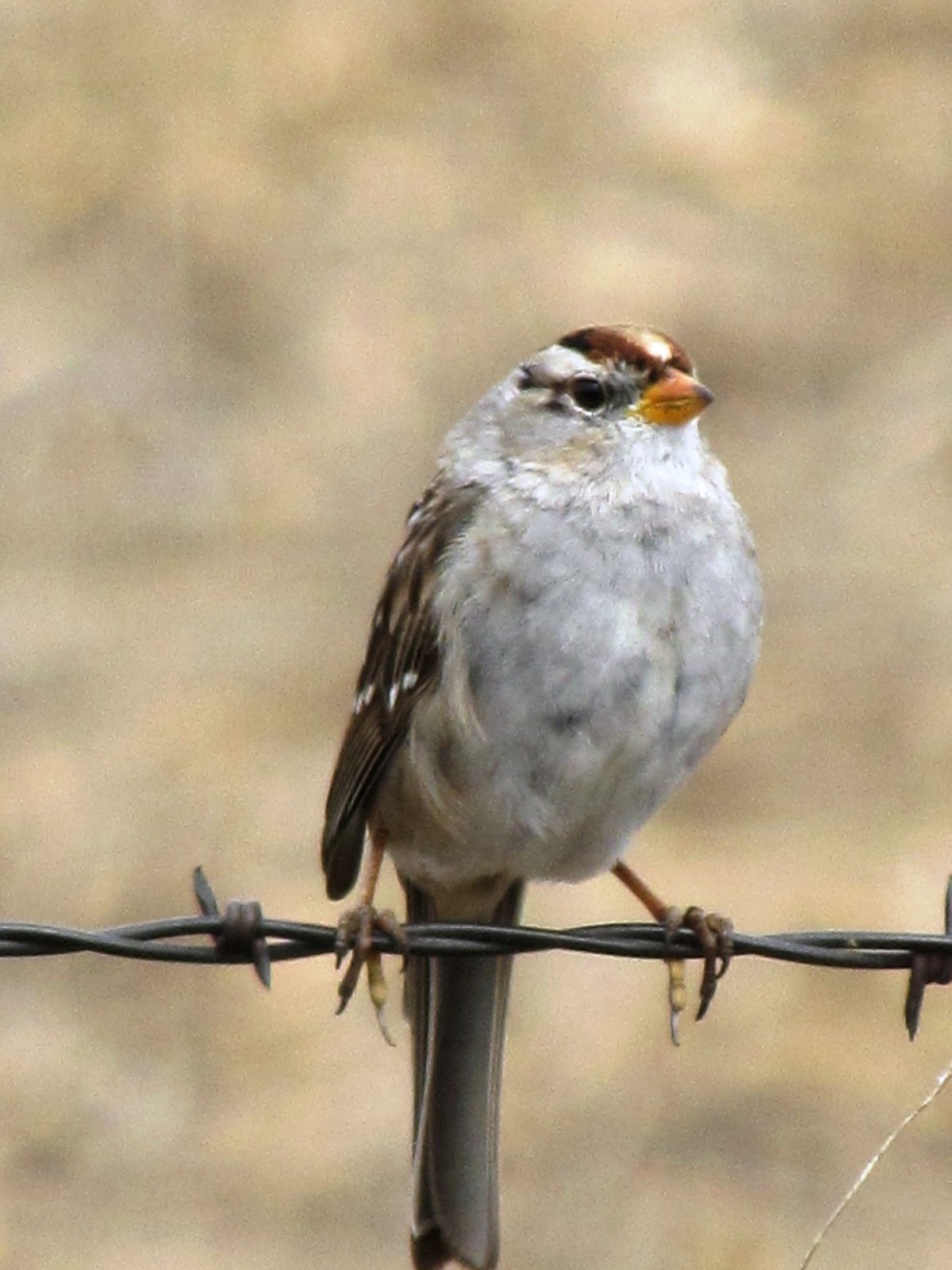
I was only in Adams county for a short bit, but picked up 16 species before I was out.  I missed Sandhill Cranes, but got all of my doves (Rock, Mourning and Eurasian Collared-Dove), a lot of blackbirds (no Yellow-headed yet though), and before I left - some White-crowned Sparrows, which were singing with a distinct accent.  These were the Gambelii subspecies, rather than the Pugetensis that I'm used to - a little grayer on the breast, and an orange-ish bill, rather than yellow.  Little things, but when you see enough of a bird, you know when something's different!  One of them posed for me:


White-crowned Sparrow - Gambelii subspecies

Off from the county line, I moved on to I-90 and the area south of Ephrata.  I totally drove around the Potholes area and Moses Lake, but will hit them in the summer!  After checking out some more possible Burrowing Owl sites, I moved on to HWY 28 which goes east to Quincy.  Here I found one of the birds I'd hoped to find on this trip - Long-billed Curlews!  A dozen of them were feeding in the field south of the highway.  Wouldn't have noticed them, perhaps, but a Northern Harrier (the 80th of the day) caught my eye.  These curlews are some funny birds.  It's like a little sandpiper was given some goose DNA, and then given bill erectile dysfunction.  Giant shorebirds with droopy bills.  They were far away, but I had to get what photos I could:
Long-Billed Curlews - East of Quincy

a closer look
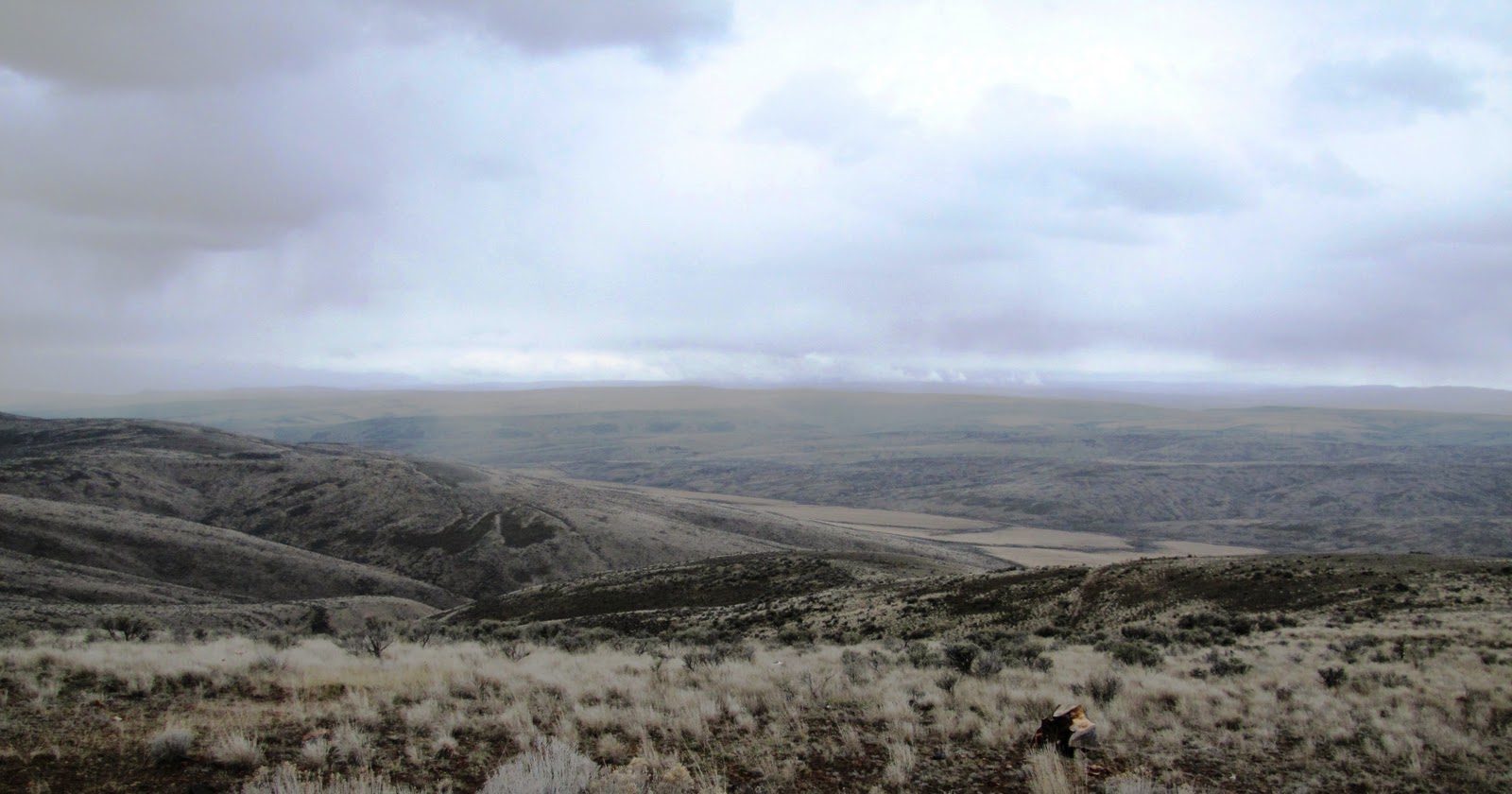
I finished the day on Monument Hill in the Beezley Hills. While I was hoping for a Sage Sparrow up here, once I took in the view from the top, it didn't matter that the only sounds around me were the meadowlarks.  I could probably see to Moses Lake in one direction, to the Columbia in another, and off into Douglas County to the north.  I'll finish this post with parts of the panorama.


Doesn't half do it justice here.  I was just stunned by how beautiful this was.  It was so big.  We don't get that in the Seattle area all that often, where you can just see forever...

Driving back with the light of the afternoon (all of this, and I was done by 3), I was struck again and again by these trees with orange - bright orange branches. I don't know what they were, but there were many of them lining the west bank of the Columbia, and I had my breath taken from me again. 

And I made it back in time for dinner! 

To Othello: Saturday morning 3/26

Came down with a fever on Thursday, so I stayed home Friday and rested up in preparation to drive our team to an invitational meet in Ephrata on Saturday.  In the late afternoon, I got a call from one of my coaches - illness, injury, and ineligibility had reduced our team considerably (and we're not huge to start with!), so that we were facing a 15 hour day with 6-7 athletes, and no relays, rather than 12-15 athletes, several relays, and lots of reasons to cheer.  I'd actually looked into what might be flying around as we drove, and was hoping to catch some cranes passing overhead during the meet, or maybe some Long-billed Curlews in the fields on the way home.  Life gave me a lemon here, so I decided to make a lemonade trip to Grant County!


Almost dawn - East of Ellensburg
 One idea I've concocted in this whole process is that it's good to get where I want to go by daylight.  Spending the first hours of dawn in King County in a car and arriving after the morning chorus was done would be less than ideal!  So I left reeaally early, and found the sky starting to light as I got on the Old Vantage Highway headed east from Ellensburg.  I was happy to hear my first Western Meadowlark of the year at an early pull-off.  Hundreds more of them would be the soundtrack to my day!


Loggerhead or Northern Shrike?
 It's spring, so the birds are just starting to change.  One change that I should have prepared for a bit better was the changing of the shrikes.  There are Northern Shrikes (which I've seen), and Loggerhead Shrikes (which I haven't).  Both of these hang out in the part of Kittitas County I was driving, and both of them are possible at this time of year.  I pulled over at the visitor center at the Gingko Petrified Forest, and was greeted by a shrike.  A quick look at it and at my Sibley, and I called it a Loggerhead Shrike - enjoyed a new life bird for a few minutes, took a picture, and continued on with my short walk.  These things are harder to tell apart than that, however, and when I got back, I had all kinds of reasons to doubt the ID.  It's on top of a tall tree, for one, which isn't what the Loggerheads usually do, and the breast in this picture is looking pretty gray - should be whiter in a Loggerhead.  I will lean towards Northern, and more importantly, leave it unidentified for now, and be better prepared in the future. 

Fossilized wood - Gingko Petrified Forest State Park
All of that aside, they really are cool birds.  The only songbirds, I believe, that will eat other birds!  They eat a lot of insects as well - nabbing them, then saving them for later by skewering them on anything sharp they can find, like thorns or barbed wire.  On the Christmas Bird Count back in December, we saw a Dunlin skewered on barbed wire, and puzzled over whether it had done that to itself or if a shrike had done it...

Petrified wood is also very cool - although I didn't do the full walk today, I snuck up the trail far enough to take a peek at some Douglas Fir that grew millions of years ago.


Dawn from Gingko PFSP

Read your signs, Tim!
 Off and away!  I made my way across the Vantage Bridge to enter Grant County for the first time this year.  On the far side, there were a few choices:  I-90 and Hwy 26 are the big east-west roads through the county, but I took a right and went further down the Columbia River to Lower Crab Creek Road.  I stopped along the way to scope the Columbia, but found very few ducks from the places I stopped, including Wanapum Dam.  Snapped a picture of a very informative sign that was too much reading for me at that hour (at right).  Was worth a read later, though, and I kind of wished that I had gazed over to the other side and thought "Firing Center", as it would have helped knit together my mental map of the state.


Saddle Mountains, sagebrush, and sand dunes


Okay, got this straight - if you head east on I-90, the Frenchman Hills are on your right.  If you head east on HWY 26, the Frenchman Hills are on your left, and the Saddle Mountains are a bit farther off on your right.  I was on Lower Crab Creek Road, which hugs the Saddle Mountains tightly.  The view above was most of the drive - beautiful dramatically sloping hills with clouds easing over their tops.  My only real stop along the way was at a short hike to Nunnally Lake, a fishing spot on the north side of the road.  Meadowlarks were still everywhere, and I also heard my first Ring-necked Pheasant of the year, calling from deep in some brush when I startled it.  The lake was also not incredibly birdy, although I did hear the chattering of Marsh Wrens.


Western Meadowlark - Grant County
Lower Crab Creek Road at its most primitive - not so bad
The road was a very easy place to bird - you could see things and pull over!  There wasn't much in the way of traffic, and the people that did come through would give you the raise-a-finger-off-of the-steering-wheel wave - very friendly.  Pulling over when I saw things flitting around in the trees helped me to find a lot of songbirds, including some Townsend's Solitaires, also the first of the year.  At one point, the road stopped being paved.  "Primitive road ahead" is not usually a good sign, but this turned out to be very drivable, even as it wound up into the Saddle Mountains a little bit. 


As I came back down from high points, and got close to the Adams county line, I saw something I was hoping to see - hundreds of Sandhill Cranes filling the sky in the distance, then coming down on a field.  From here, I couldn't make my way over to where they had landed, and I didn't get a shot of them in the air.  I'll include my Sandhill Crane picture in the next post (oh it's something to see...).


The Grant/Adams county line from Lower Crab Creek Road